So you have everything planned perfectly; the lighting, media, a camera to capture the moment, and it all goes cold! What went wrong? Cells in vitro tend to be very moody about their environment and nothing kills the mood quicker than getting cold. Two important elements of imaging with high numeric aperture lenses that need addressed are, first the method of which the specimen is being heated and secondly the heat sink factor of the objective.
The biggest problem with using peripheral heating systems such as stage heaters and stage top incubators is that it relies on the heat from the base to radiate to the specimen when a large percentage of that is absorbed by the microscope. Unsurprisingly, this causes a temperature variant across the specimen plane that heavily effects the cells growth and behavior. With such an inefficient heat transfer the re-equilibration time with changes in temperature or media introduction tends to be very slow.
Delta T Thermographic Image
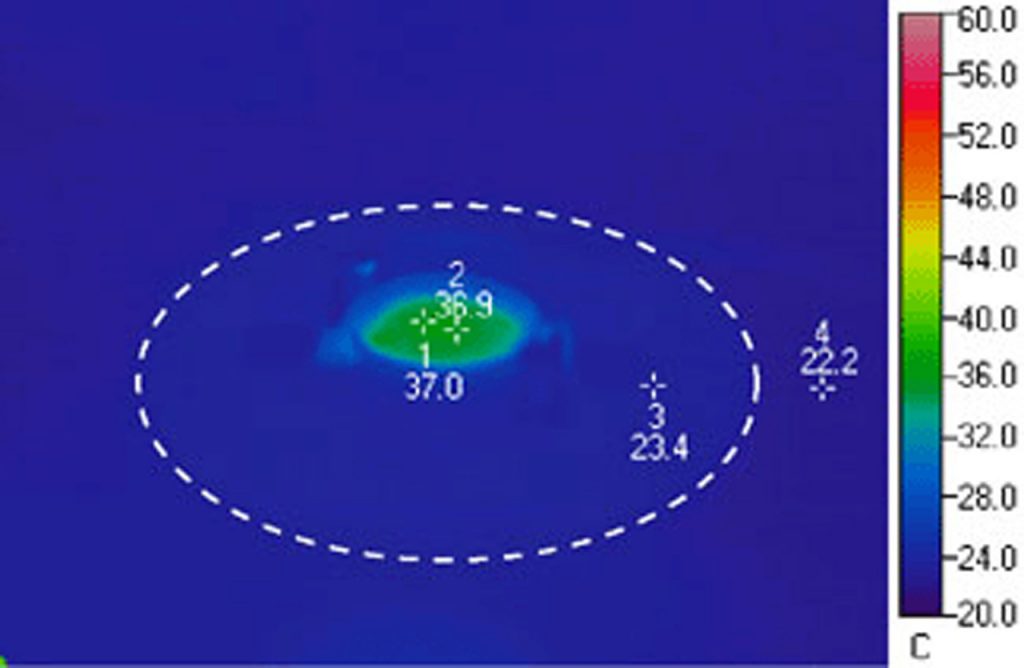
The thermograph to the left indicates the disadvantage of peripheral heating. This is a thermal image of a 50mm culture dish in the center of a 100mm diameter uniformly heated, 3mm thick, aluminum plate with a 25 mm hole in the center. This image was acquired after 20 minutes of equilibration. Note the high temperatures of nearly 60° C, that it takes to reach 37° C in the specimen area. In this case heat that is not beneficial to the specimen is sunk into the stage causing Z-axis instability. In contrast the thermograph on the right shows the efficiency, accuracy and uniformity of a heating system that directs efficient heat to only the specimen (Delta T™ system). Notice the temperature of the stage adapter. It is nearly the same temperature as the room temperature background. The dotted oval shows where the edge of the stage adapter is in visible light. Only the specimen and media are heated. Power consumption is 0.9 watts because heat is only applied to the specimen area. There is no heat transmitted to the stage.
Radiant Stage Heater Thermographic image
Once the specimen is being heated accurately there still remains the problem of the objective acting as a heat sink. In this instance the optical coupling medium (oil, glycerin or water) acts as a thermal coupling medium and draws heat away from the specimen. The thermal mass of a fluid coupled objective is overwhelming when compared to the thermal mass of the cells. To eliminate this thermal gradient, it is important to accurately and carefully warm your objective (Objective Heater). It may also be necessary to isolate the objective from the nosepiece turret for proper objective temperature regulation with a Thermal Spacer.
When selecting an objective heater it is essential to select one that is referencing the temperature on the focal plane of the objective since this is the point that can affect the specimen. By using a system that is specifically designed to slowly heat the objective then hold the objective at the set point value you have eliminated the cooling factors that prevent cells from their natural behavior all while protecting your objective from damage of overshooting and inefficient heating.
Thermographic image of a Bioptechs Objective Heater